
Monroe County Projected Release Dates
A projected date is a calculation, not proof that a gate release occurred. Florida law calls FDC's calculated date a tentative release date. The current FDC profile labels the public field Current Release Date and warns that it can change after gain-time awards, forfeitures, or review. If the field reads “TO BE SET,” FDC has not completed its review.
An actual date records a completed custody event. For MCSO, the seven-day release table can show a release timestamp and facility. For FDC, a past release event and released status are stronger evidence than a future date. A court order may authorize release before identity checks, another case, a detainer, or transport is cleared.
An official FDC record example shows the live Current Release Date label and its change warning on a state profile.
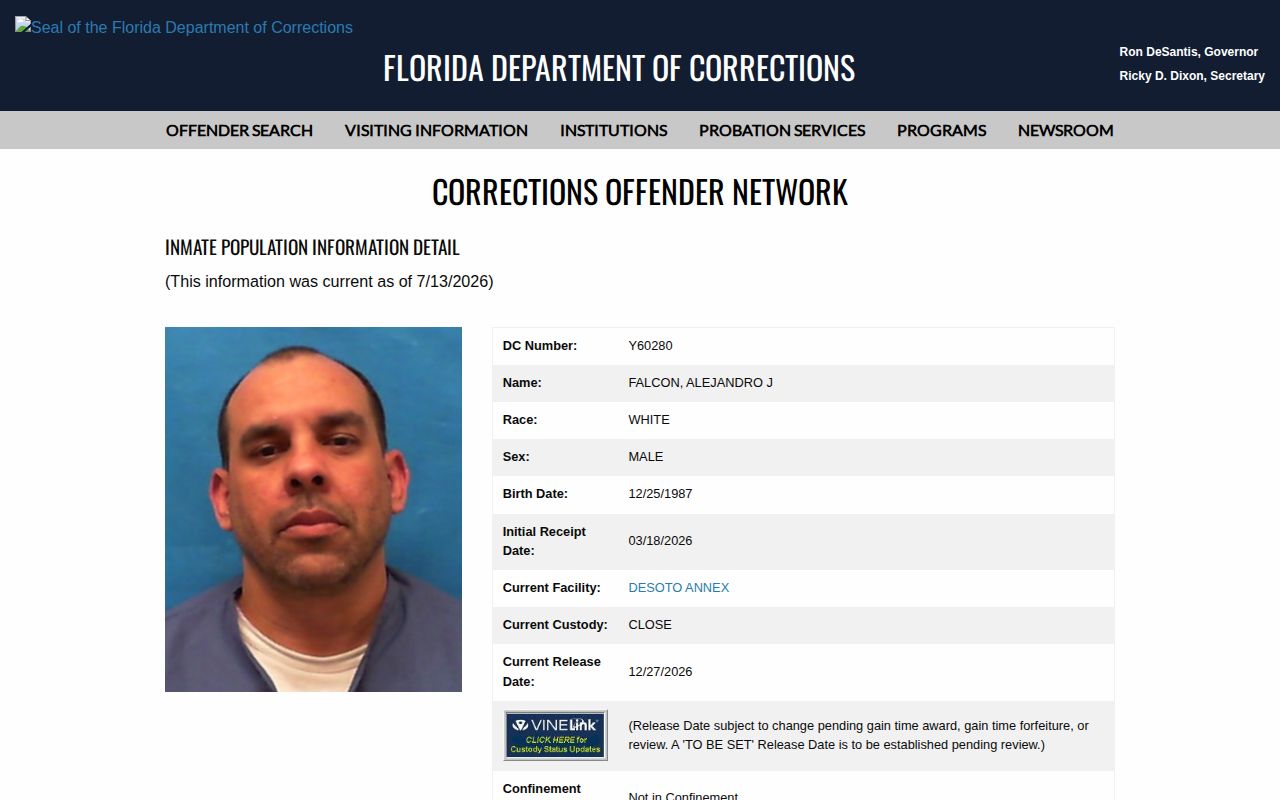
The screen demonstrates where the public field appears, while the surrounding status and history remain necessary for a completed-release finding.
Pretrial detainees have no sentence-based release date. Their path may turn on bond, own recognizance, Pretrial Services, dismissal, a later sentence, or a hold. The Monroe Clerk docket supplies the legal events; MCSO supplies the physical release or transfer event.
Find a Monroe County Release Date
Begin with custody type. FDC does not cover a person who only stayed in an MCSO jail and never entered state prison or FDC supervision. Conversely, the current MCSO jail log cannot supply the computed date for a state prisoner. Use the agency that holds or sentenced the person.
- Confirm identity with full name, date of birth, booking number, case number, or DC number. A name alone is weak.
- For state prison, open the FDC Offender Search and use the current-inmate, release, or all-database population that fits.
- Read the Current Release Date, status, facility, sentence data, and movement or release history actually displayed.
- For a county-jail sentence, search the Monroe Clerk criminal docket for the sentence and jail credit, then request MCSO's existing calculation record.
- For a pretrial case, review bond and release orders, Pretrial Services entries, and holds. Do not calculate an exit date.
- On or after the date, confirm a completed release or transfer with MCSO, FDC, the docket, or the receiving custodian.
The broader Monroe County released-inmate lookup explains how to follow a transfer to FDC, ICE, USMS, another county, or the community. That distinction matters because leaving one roster does not always mean freedom from custody.
Florida Release Date Search Fields
FDC's Offender Network separates current inmates, inmate releases, supervised people, absconders or fugitives, escapes, and an all-database search. The release database includes state inmates who have been released or are scheduled for release. FDC reports nightly updates for release information and release-date or location changes, while full current-inmate data refreshes weekly. That cadence belongs to FDC, not MCSO.
| Field or choice | What it means | Use |
|---|---|---|
| DC number | Florida corrections identifier | Strongest direct match |
| Population filter | Current, released, supervised, or all records | Prevents an incarcerated-only search from hiding a release |
| Current Release Date | Public FDC date subject to change | Planning, not completed-release proof |
| Status and location | Custody, released, or supervision state | Shows which part of FDC still applies |
| Release history | Past state custody events | Supports completed state release |
A state release can lead straight to conditional release or another supervision form. A past date proves departure from prison, while the supervised-population record shows whether FDC involvement continues.
Note: FDC's nightly release update does not guarantee that a court, county, federal, or immigration record changed at the same time.
Florida State Release Computation
FDC first establishes the maximum sentence expiration date and applies lawful credits. A new or consecutive sentence entered before full release can extend that maximum. Escape time or parole-violation time can also affect the computation. Gain-time granted or restored moves the tentative date earlier; forfeiture moves it later. The tentative date cannot exceed the maximum sentence expiration date.
Florida Statutes §944.275 contains date-specific gain-time rules. Historical basic and incentive rates differ. Some older periods allowed larger monthly awards, while eligible offenses after October 1, 1995 generally fall under a framework with up to ten days per month of incentive gain-time. Meritorious and educational awards have their own limits. Serious-offense exclusions and offense-date bands must be applied by FDC.
For covered post-October 1, 1995 sentences, gain-time cannot reduce service below 85 percent of the term imposed. Court-awarded credit for actual incarceration counts toward that floor. This is a minimum-service rule, not a promise of release at exactly 85 percent. Multiplying a sentence by .85 ignores jail credit, sentence structure, mandatory minimums, eligibility, awards, forfeitures, and later review.
Section 944.291 also explains why gain-time release can lead to supervision. The date at the prison gate and the date all legal control ends may differ.
Monroe County Jail Good Time
County-jail calculations follow a different statute. Florida Statutes §951.21 authorizes county-prisoner gain-time unless the county commission changes or ends the policy. With no sustained misconduct, the statute allows up to five days per month during the first two years, up to ten during the third and fourth years, and up to fifteen during the fifth and later years. It also permits an extra policy award of up to five days per month for meritorious conduct or exceptional industry and allows forfeiture.
Those caps do not prove what any Monroe County inmate earned. Section 921.161 requires specified credit for time spent in county jail before sentence. The sentencing court supplies the judgment and credit, while the jail performs its calculation. MCSO's public release table shows no projected date, credit ledger, or formula.
Request the existing sentence calculation from MCSO Central Records through the official records portal. Identify the person, booking number, facility, case, sentence date, and exact calculation sought. Ask for an estimate before extensive work. Do not build a date from sentence length alone.
Note: The county gain-time statute and FDC's 85-percent framework govern different custody systems and should never be blended into one estimate.
Why Monroe County Release Dates Change
A release date can move for legal, custodial, and records reasons. Some changes alter the sentence computation. Others leave the sentence date intact but prevent community release because another authority is waiting. Read the record for the named factor instead of guessing from a changed web field.
| Factor | Possible effect | Best confirmation |
|---|---|---|
| Gain-time award or restoration | May move an FDC tentative date earlier | FDC calculation record |
| Disciplinary forfeiture | May move the date later | FDC or jail ledger and order |
| New or consecutive sentence | Can extend maximum expiration | Court judgment and FDC record |
| Mandatory minimum or review | Can limit or pause computation | Judgment, statute, calculating agency |
| Detainer or another warrant | May cause transfer instead of community release | Release record and receiving custodian |
| Court correction or jail credit | Can change lawful time remaining | Monroe Clerk order and calculation |
| Parole or conditional-release action | May change the release mechanism or supervision | FCOR final order and FDC status |
A zero bond amount on the MCSO release table does not explain which factor applied. The docket or agency record must identify the release authority and destination.
Monroe County Release Record Sources
The MCSO page titled “Inmate Releases for the Last Seven Days” provides actual local release timestamps, not projected dates. It shows name, birth data, facility, booking date and time, release date and time, and bond amount. It has no release reason, destination, charge, photo, or supervision field. Its data was observed stale during the July 2026 research review, so inspect the newest timestamp and do not rely on the title alone.
The Monroe Clerk docket can show the sentence, jail credit, bond order, dismissal, probation, or later correction. It may preserve the legal history after the short MCSO display expires. Yet a docket order time and physical gate time can differ. MCSO may still need to clear identity, other cases, holds, and transport.
If the county record points to a state sentence, search FDC after intake lag. If it points to federal or immigration custody, use the federal docket, BOP, or ICE system as appropriate. USMS has no public historical release locator.
Confirm Monroe County Actual Release
Check again when the projected date arrives. For MCSO, look for a completed release timestamp and named facility, then obtain the movement or release record if destination matters. For FDC, seek released status and a past event. A current-custody roster drop alone is not proof.
Florida VINE can send a time-sensitive custody-change notice for MCSO and FDC records. Register on the correct agency episode because one person can have both. The VINE Inmate Check explains that workflow. A VINE notice can distinguish events such as release, transfer, return, or another jurisdiction, but the originating record remains the durable source.
When sources conflict, contact MCSO Central Records at 305-292-7050 for county records, FDC Admission and Release at 850-488-9167 for state release questions, or the Monroe Clerk criminal records line at 305-295-3950 for docket documents.
A written state request can ask FDC for the movement and release record, the public sentence-release calculation record, and the release type tied to the DC number. Send a precise request through the FDC public-record portal when the profile does not resolve a change. For a county calculation, ask MCSO for the record it already keeps and cite the booking and court case. Neither office should be asked to create a new estimate. A produced ledger or agency calculation is more reliable than arithmetic based on a web sentence summary.