
Monroe County 72-Hour Release Window
The Monroe County Sheriff's Office publishes Inmate Releases for the Last Seven Days. Research found no distinct official rolling 72-hour page or URL. A three-day view is made by comparing the release date and time in each row with the current time and selecting entries from the previous 72 hours. It is a useful method, but the result remains a reader-derived slice of the official seven-day product.
The broader span can recover events missed during two or three days away from the source. It also provides more room to compare multiple booking episodes. Still, the table's own newest timestamp must fall within the period being searched. An old row under a “last seven days” heading cannot establish a current weekend release.
Calculate Monroe County 72-Hour Releases
Use one fixed observation time for the whole review. Otherwise, entries near the edge of the period can shift while the check is underway. Write down that observation time and follow the same identity rules for each row.
- Open the official MCSO seven-day release table and inspect its newest release timestamp.
- Set the cutoff exactly 72 hours before the recorded observation time.
- Keep rows at or after that cutoff and reject rows older than it.
- Match full name, date of birth or age, facility, and booking date across the selected records.
- Compare the live jail log, then use the Clerk docket or MCSO records when a status or destination is unclear.
The calculation should use date and time, not calendar dates alone. A Monday evening review reaches back to Friday evening, not to the start of Friday. Readers who need only today's changes can use the Monroe County 24-Hour Releases method instead.
Note: Save the observation time and cutoff so another person can reproduce the same three-day review.
Monroe County 72-Hour Release Fields
MCSO supplies the same fields for every row in its seven-day display. The release time and facility are central to a three-day review, while identity fields keep similarly named people apart. Missing fields must be obtained elsewhere.
| Field | Use in a 72-hour review |
|---|---|
| Last name; first name/MI | Begins the match but cannot safely stand alone. |
| Date of birth; age | Helps distinguish people with similar names. |
| Facility | Shows which Monroe detention location is attached to the event. |
| Booking date/time | Separates custody episodes and helps link an arrest record. |
| Release date/time | Determines whether the row falls inside the 72-hour cutoff. |
| Bond amount | Shows the listed amount, not the reason for release. |
No public column provides a photograph, charge, release reason, case number, destination, or supervision status. A row may mark community release, transfer to Florida prison, movement to another county, or a federal or immigration handoff. The docket or underlying release record supplies the missing legal context.
Monroe County Weekend Release Review
A 72-hour span is practical after a weekend because it includes more than one shift and more than one calendar day. Yet there is no special MCSO weekend feed, and the research does not establish a different holiday publishing schedule. The correct response to a missing weekend entry is verification, not an assumption that no release occurred.
Court authority and physical processing also occur on different clocks. A bond order, recognizance decision, or Pretrial Services action can precede the MCSO release time while paperwork, identity checks, other cases, or holds are reviewed. A docket entry can also be posted after the actual event. Compare the MCSO time, the judicial record, and any PTS report without forcing them into one timestamp.
Audit Monroe County Release Freshness
Monroe's local data quirk requires a separate freshness audit. On July 14, 2026, the official release backend still reflected a May 15, 2025 update and included an April 28, 2025 release, despite the page's seven-day title. The current jail log carried a current “as of” timestamp. That mismatch demonstrates a stale or malfunctioning release source, not an absence of newer releases.
For a three-day review, compare four points: the page title, the newest displayed release time, the access time, and the jail log's current timestamp. The newest release must be plausible for the target period. If the release table is old while the jail log is current, stop using it as a complete 72-hour list and move to records and docket sources.
The official MCSO current jail log image in the manifest shows the companion roster and its time-based role. It can reveal current MCSO custody but cannot explain a past roster disappearance.
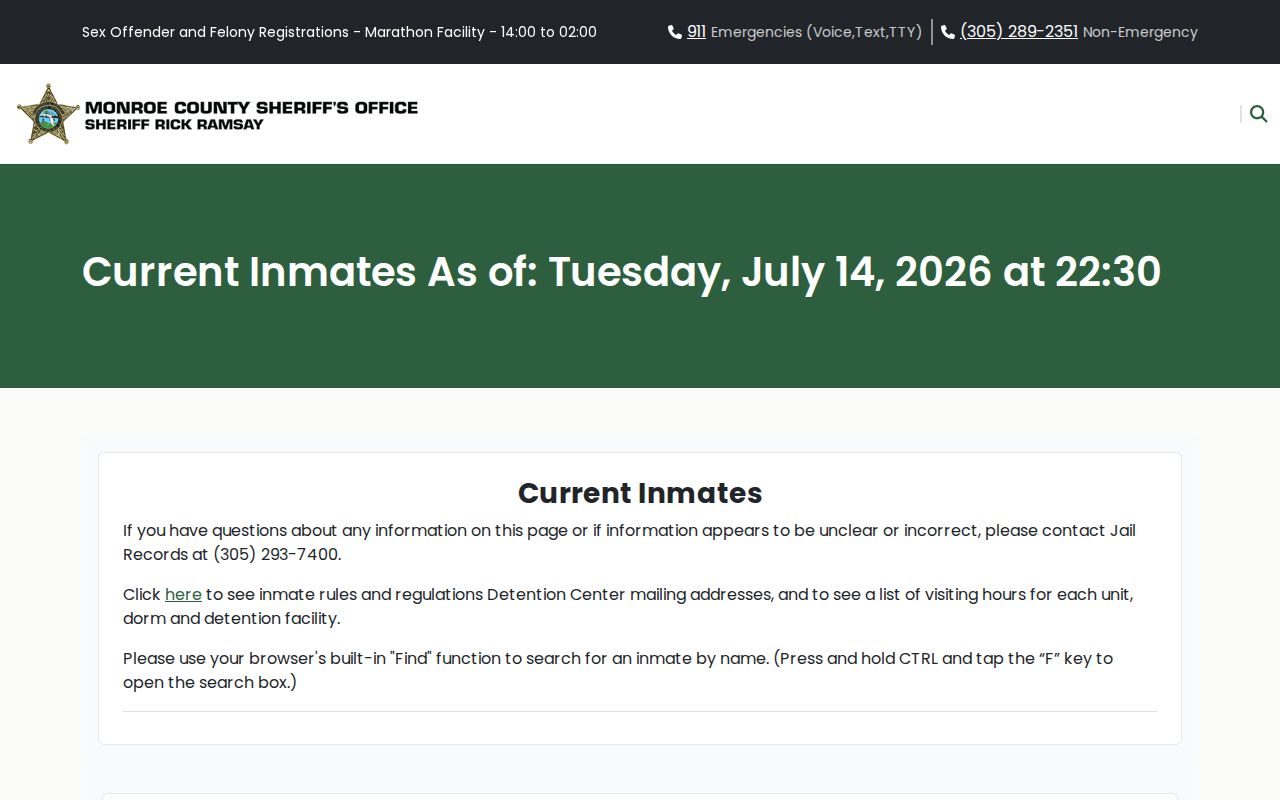
The current log and release table answer opposite questions, so both need their own timestamp check.
Note: A current jail-log timestamp does not cure an old release table or prove why a name disappeared.
Monroe County Release Facility Paths
MCSO operates detention facilities at Stock Island, Marathon, and Plantation Key. The facility column helps locate the event, which matters across the long geography of the Keys. A person held briefly in Marathon or Plantation Key may move to Main. That internal transfer is not a release to the community.
Other transfers can end the MCSO booking while custody continues elsewhere. A sentence of a year or more can lead to FDC intake. A federal writ, another county's warrant, or an immigration detainer can lead to a different custodian. Search FDC after intake when state prison is shown, use the federal docket for U.S. Marshals pretrial custody, and use the relevant federal locator when supported by the record.
- Release
- The end of the reporting jail's custody transaction.
- Transfer
- Movement from one facility or custodian to another.
- Disposition
- A court result in the case, which may not be the physical release time.
Monroe County Release Companion Records
The separate MCSO arrest page can retain a recent arrest and booking photo after a person leaves the live jail log. It has no release field. Match name, birth details or age, arrest or booking time, and the release row rather than relying on appearance. The official app documents arrest search and sorting, but no primary source proves a dedicated recent-release module.
The Monroe Clerk criminal docket is more durable. It may show bond or release authority, disposition, sentence, jail credit, probation, termination, or a sentence that caused transfer to FDC. Weekly Pretrial Services reports can include a Date Released to PTS. That is community pretrial release with an active case, not proof that the case ended.
Keep booking time, release time, and court-order time in separate notes. Booking time starts the Monroe County custody episode. Release time ends the MCSO transaction. An order date records judicial action and may come before processing ends or appear on the docket later. The three values can all be accurate without matching. When a bond amount appears in the release table, it still does not identify who posted it, whether another hold existed, or which order finally allowed the person to leave MCSO custody.
Recover Missing Monroe County Releases
When the table is empty, stale, or outside the useful period, the MCSO public-record portal is the direct county fallback. Ask for the existing release or movement record tied to the person's name, date of birth if known, booking date, and facility. Request an estimate because no full MCSO release-record fee schedule was located.
Florida VINE can send a time-sensitive custody-change alert for MCSO and FDC records, but it is not a certified long-term archive. FDC Offender Search is appropriate only for someone who entered Florida prison or state community supervision. A person held only by MCSO will not become an FDC release record merely because the county table expired.
For a single named person, the Monroe County release search combines these county, court, state, and federal routes. Negative results remain inconclusive because spelling, aliases, source retention, confidential records, and custody changes can all affect a search.
Confirm Monroe County Release Status
A three-day list answers when MCSO ended a transaction. It does not, by itself, answer whether the person returned home, began supervision, entered state prison, or moved into federal or immigration custody. Use at least two identifiers and follow the custody path shown by the record.
| Question | Source |
|---|---|
| Still in an MCSO jail? | Current jail log with its “as of” time |
| MCSO release or transfer time? | Seven-day release table or MCSO movement record |
| Why did county custody end? | Monroe Clerk docket and MCSO record |
| Entered or left Florida prison? | FDC Offender Search and FDC records |
Use the agency's exact status and event terms. “Out of MCSO custody” and “free from all custody or supervision” are not equivalent statements.
A no-result is also inconclusive. Aliases, initials, hyphenated names, data lag, source retention, sealed or confidential records, and a different custodian can all explain an absence. Record the query, source, population, and search time before moving to the next system.