
Monroe County 24-Hour Release Source
There is no distinct official MCSO 24-hour release feed. The official source is the Sheriff's Inmate Releases for the Last Seven Days page. To form a same-day view, compare each displayed release date and time with the current time and keep only events that fall within the prior 24 hours. That subset is calculated by the reader. It must not be described as an official MCSO 24-hour product.
The seven-day table reports an MCSO release transaction. It does not say where the person went. Someone may have returned to the community after bond, recognizance, Pretrial Services, dismissal, or time served. The same event could instead mark delivery to FDC, ICE, the U.S. Marshals Service, another county, or another authority. When destination or legal basis matters, the row must be paired with the Monroe Clerk docket or an MCSO record.
Check Monroe County Same-Day Releases
Begin with the release table, then verify the booking episode and custody path. This order keeps the current jail log from being mistaken for a release archive and helps separate a community release from a transfer.
- Open the official MCSO seven-day release table and note the newest timestamp shown.
- Compare each release date and time with the present time. Retain only rows within the prior 24 hours.
- Match the full name with date of birth or age, facility, and booking date. A name alone is not enough.
- Check the current jail log. A current entry means the person is still shown in MCSO custody, but absence alone does not prove release.
- Use the Monroe Clerk docket or MCSO records when the release reason, destination, or timing remains unclear.
For a search centered on one named person rather than today's group of releases, use the Monroe County released inmate search path. It continues beyond the brief MCSO display to court, state, and federal sources.
Note: Record the access time because a rolling 24-hour calculation changes as each minute passes.
Monroe County Release List Fields
The MCSO table has strong identity and timing fields, but several details people often expect are absent. Read the fields as written. In particular, a bond amount is not a release reason and does not prove who paid it.
| Field | What it shows |
|---|---|
| Last name and first name/MI | The identity text attached to the MCSO release row. |
| Date of birth and age | Matching details that help separate people with similar names. |
| Facility | The Monroe detention location associated with the transaction. |
| Booking date/time | When that MCSO custody episode began. |
| Release date/time | When MCSO completed the release or transfer transaction. |
| Bond amount | The amount displayed for the booking, not proof of the release basis. |
The public table does not show a photo, charge, case number, release reason, destination, or supervision status. Those gaps are important. A zero bond amount cannot be translated into time served or dismissal, while a nonzero amount does not prove that all holds cleared at that moment.
Monroe County Jail Release Times
The January 2026 MCSO inmate handbook gives the local answer to a common timing question. A sentenced inmate may be released any time after 8:00 a.m. on the scheduled date. Other releases occur as soon as possible after written legal authority arrives, subject to command authorization. This is not a promised 8:00 a.m. exit and does not create one universal gate time.
Bond, court, and administrative releases depend on written authority and the clearance of other cases or holds. The release timestamp can therefore come after a court order. Identity checks, transport, another warrant, or a receiving custodian can add more time. The docket date and the physical release time answer different questions and should not be substituted for each other.
Note: A scheduled date starts a process; the MCSO release timestamp records the completed county transaction.
Travel After Monroe County Release
The geography of the Florida Keys makes the releasing facility especially important. Main is on Stock Island, while MCSO also operates detention locations in Marathon and Plantation Key. A family member should confirm the facility and destination before starting a trip. An internal move from a satellite location to Main is not a community release.
Monroe County Transit publishes the current Lower Keys Shuttle route along U.S. 1 between Key West and Marathon. Its route material includes Stock Island-area stops, but that does not establish a jail-door pickup or a guaranteed connection. Check the live route and schedule before travel, and do not infer a departure point from the word “Monroe” alone.
Monroe County Pretrial Releases
Sixteenth Judicial Circuit Pretrial Services interviews and screens Monroe defendants, makes recommendations at first appearance or bond-reduction hearings, and supervises court-ordered conditions after release. The MCSO handbook also says Pretrial Services speaks with inmates before first appearance about release options.
A Clerk weekly report may show a “Date Released to PTS.” That means the person entered community pretrial supervision while the case remained active. It does not mean the charge was dismissed, the sentence ended, or the person was released with no conditions. Compare the PTS date with the MCSO time and the individual docket, since the three sources document different parts of the same case.
Monroe County Release Data Freshness
The most important local data check is the newest timestamp, not the heading alone. During research on July 14, 2026, the backend supporting the official release page still showed a May 15, 2025 update and returned an April 28, 2025 release. At the same time, the live jail log showed a current “as of” time. This conflict shows that the release display can become stale or malfunction.
That observed condition does not mean Monroe County had no later releases. It means the public table could not answer the question reliably at that point. Inspect both the visible release row and the live jail-log timestamp. If they conflict, use the Clerk docket and MCSO records rather than drawing a conclusion from an empty or old table.
The official MCSO release-page view in the manifest shows the table layout and headings. The image connects the displayed fields to the same-day calculation described above.
View the official MCSO release source before relying on its current entries.
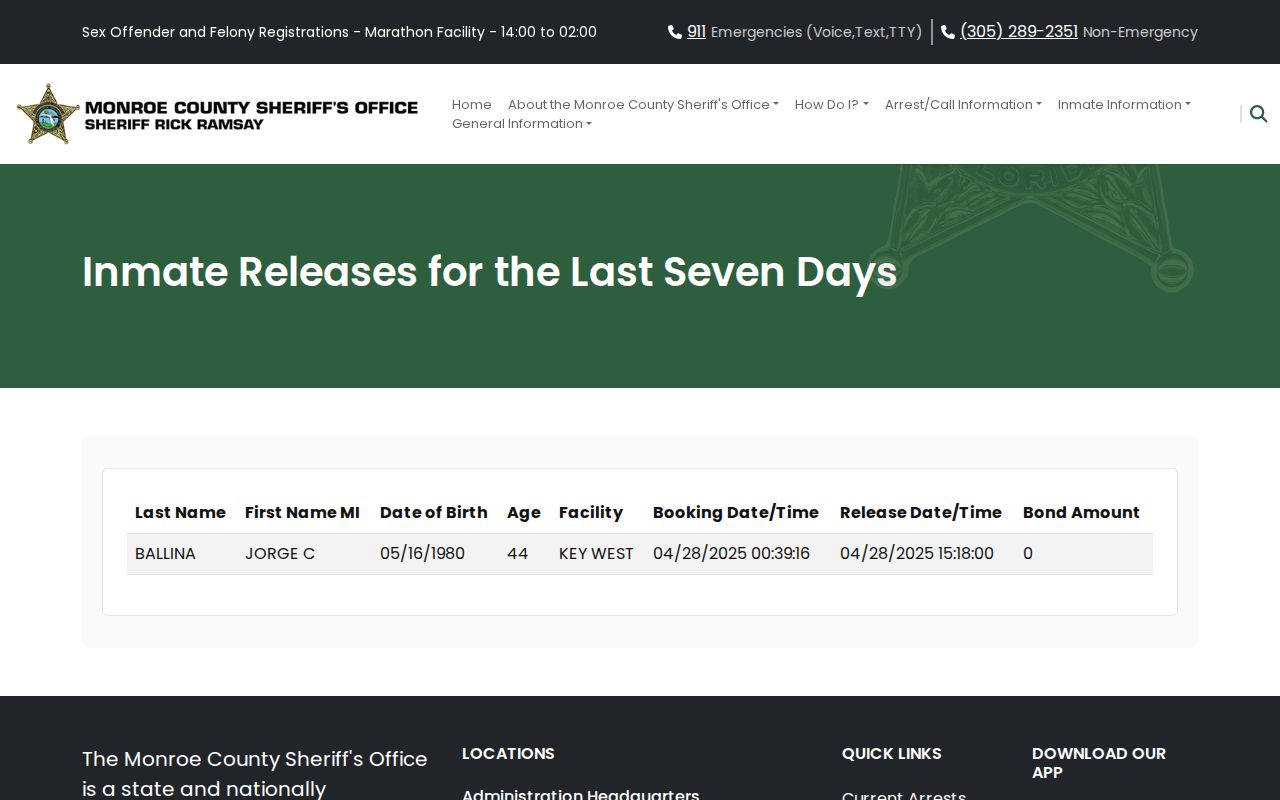
The newest release date and time in the live source, not the captured example, controls any present-day 24-hour calculation.
Monroe County Release Photo Match
The MCSO release table has no photograph. The separate seven-day arrest page can display a booking photo and arrest details, while the official mobile app's version history documents arrest search and sorting. Neither source independently proves that a release occurred. The app listing also does not establish a dedicated release module or a released-photo archive.
Match the arrest episode to the release row through name, date of birth or age, booking or arrest time, and other shared identifiers. A person may remain on the arrest display after leaving the current jail log. That can help with identity, but only the release timestamp, agency record, or court source verifies the custody change.
Note: A booking image identifies an arrest episode; it does not state present custody, release reason, or destination.
Monroe County Release Record Fallbacks
When the public table is stale, missing a row, or beyond its stated seven-day window, request the existing movement or release record through the MCSO public-record portal. Include the full name, date of birth if known, booking date, facility, and the event being sought. Ask for a cost estimate because no comprehensive MCSO release-record fee schedule was located.
The Monroe Clerk criminal portal can preserve the bond order, disposition, sentence, jail credit, probation order, or transfer-producing sentence after the short release display expires. Florida VINE can provide a time-sensitive custody-change alert. FDC Offender Search applies only if the person entered Florida prison or state community supervision. Federal and immigration custody require their own sources.
For a slightly broader recent window, the Monroe County 72-Hour Releases page explains how to calculate three days from the same official table. It does not replace the records fallback.
Monroe County Released Versus Custody
A person still displayed on the live MCSO jail log remains shown in county custody. A person absent from that list may have been released, transferred, moved between Monroe facilities, or omitted because of a data issue. Roster absence is therefore not proof of release.
| Situation | Best confirmation |
|---|---|
| Current MCSO custody | Live jail log with its “as of” timestamp |
| Recent MCSO release or transfer | Seven-day release timestamp plus records or docket |
| Florida prison intake or release | FDC Offender Search and FDC records |
| Federal or immigration handoff | Federal docket, BOP, or ICE source as applicable |
Always report the agency's exact event. “Released by MCSO” can mean MCSO custody ended while another custodian immediately began holding the person.