
Understanding Monroe County Releases
“Released” describes the end of one agency's custody event. It does not always mean the person walked out to the community. The Monroe County Sheriff's Office may record a bond release, recognizance, Pretrial Services placement, time served, a dismissed charge, or a completed county sentence. It may also close the local booking when it sends someone to the Florida Department of Corrections, another county, the U.S. Marshals Service, or ICE. The destination determines which record should be checked next.
A person who leaves an MCSO detention facility normally drops from the live jail log. The official seven-day release table can preserve the local time and facility for a short period. A court docket explains the legal authority, while an internal movement or release record may identify the receiving agency. State prisoners move to the FDC offender system. Federal and immigration transfers require separate federal tools. These sources answer different questions, so one result should not be stretched beyond its field or custodian.
A missing name on the live jail log is not release proof. Confirm the event through a timestamp, court order, or agency record.
Monroe County Release Paths
The public MCSO release table does not display a reason or destination. Bond amount alone cannot supply one. A zero amount, for example, may arise from several kinds of court action. The docket or requested release record must show the authority. The most common paths can be sorted by where the person should appear next.
| Release path | What it means | Best next source |
|---|---|---|
| Bond or recognizance | The court permits community release while the case continues. | Monroe Clerk docket and MCSO release row |
| Pretrial Services | Court-ordered community supervision begins before disposition. | Case docket and weekly Pretrial Services report |
| Time served or dismissal | The local custody basis ends, subject to any other hold. | Court order plus MCSO release record |
| State commitment | MCSO transfers the person into Florida prison custody. | FDC Offender Search after intake |
| Federal or ICE transfer | Local custody ends but another custodian may take control. | Federal docket, BOP locator, or ICE ODLS |
- Discharge
- The formal end of a custody or supervision status.
- Time served
- A sentence satisfied by credit for time already spent in custody.
- Detainer
- A request or hold tied to another agency's authority.
- Remand
- A court direction returning a person to custody.
Monroe County Release Record Fields
The short-window public record is a row on the MCSO page titled “Inmate Releases for the Last Seven Days.” It is strong evidence of when MCSO completed its transaction and which listed facility handled it. It is not a full narrative. Readers who need the release reason, legal authority, or receiving agency must pair the row with the case docket or request the underlying release and movement entries.
| Public field | What it establishes |
|---|---|
| Last and first name or middle initial | The displayed identity, subject to name matching |
| Date of birth and age | A second identity check for similar names |
| Facility | The MCSO location that recorded the event |
| Booking date and time | The start of that local booking episode |
| Release date and time | The completed local release or transfer transaction |
| Bond amount | The amount shown, not the reason, payer, or destination |
Booking time, release time, and court-order time must remain separate. Paperwork, other cases, identity checks, transportation, and holds can place hours between a judicial act and physical processing. A later docket entry may also document an earlier event. For state custody, FDC's “Current Release Date” can be a future projection; completed release needs a released status and past event. The record should always be read in the context of the agency that created it.
Request Monroe County Release Records
Send a county-jail request to MCSO, not the Monroe County Commission's general portal. The MCSO public-record portal is the preferred channel. A narrow request makes identity, dates, facility, and desired fields clear while allowing the custodian to estimate any charge before work begins.
- Identify the person by full name and date of birth, booking number, or another known identifier.
- Give an approximate booking and release range and name Main, Marathon, or Plantation Key when known.
- Ask for the booking and release timestamps, release type or authority, booking photograph, and destination or receiving agency if recorded and public.
- Choose electronic delivery and request an estimate before costs exceed a stated limit.
- Ask for the statute supporting each redaction or withholding, then narrow the request if extensive work would raise the fee.
5525 College Road
Key West, FL 33040
305-292-7050
Online records request
Florida law calls for prompt acknowledgement and a good-faith response, but it sets no fixed number of days. Default copy charges may reach fifteen cents for a one-sided page, with added cost for two-sided or other copies. Extensive clerical, technical, or supervisory work can support a special-service charge based on actual resource cost. MCSO did not publish a complete release-record fee schedule or records-office hours in the source sweep, so request an estimate instead of relying on Clerk fees or hours.
Florida Law on Monroe Releases
Florida Statutes §119.01 states the public-record policy, and §119.07 governs inspection, copies, fees, redaction, and exemption explanations. Access remains subject to specific limits. Juvenile matters, protected victim data, sealed or expunged records, confidential personal details, and qualifying investigative material may be withheld or redacted. No page can promise that every field will be public.
The Monroe Clerk portal usually lasts longer than MCSO's seven-day display. It reports broad docket coverage from about 1990 and documents from about 2007, while excluding sealed, expunged, juvenile, and other confidential matters from anonymous results. Retention varies by custodian: FDC and BOP keep historical released populations, ICE describes a much shorter recently released window, and no firm post-release retention period was found for VINE.
Sealing and expunction are separate from release. Florida's process begins with an FDLE Certificate of Eligibility, then a petition and court decision. Monroe publishes its own petition and affidavit forms. The certificate is not the order, and relief takes effect only after implementation. Because an expunged record can become unavailable even to the person without a court order, needed personal or legal copies should be preserved before relief.
When Monroe County Releases Occur
MCSO's January 2026 inmate handbook gives different rules for scheduled and court-driven releases. A sentenced person may be processed at any time after 8:00 a.m. on the scheduled date. That is not a guaranteed 8:00 a.m. exit. Bond, dismissal, and other releases occur as soon as possible after written legal authority reaches the facility, unless command staff authorizes another course. Paperwork, holds, property return, and transport can affect the actual time.
The release table's timestamp is therefore more useful than a predicted gate time. Families should not infer that a court order means the person is already outside. The MCSO handbook is the source for system rules, while the individual release record proves the event. A scheduled date belongs to planning; a completed timestamp belongs to verification.
Note: MCSO publishes no universal gate appointment, so confirm the completed release before arranging a pickup at any Keys facility.
Travel After a Monroe Release
The geography of the Keys makes the named facility important. Main is on Stock Island, Marathon serves the Middle Keys, and Plantation Key serves the Upper Keys. The Monroe County Transit route page describes the Lower Keys Shuttle along U.S. 1 and lists Stock Island-area references, including a stop across from the Sheriff station. That route information offers geographic context, not proof of a jail-door pickup or a timed connection.
Confirm the facility, actual destination, and current transit schedule before travel. A release row marked Marathon may reflect a community exit or a movement within the MCSO system. A person sent to Main, FDC, USMS, or ICE needs a different plan. The agency record and court docket should settle the destination before anyone crosses the county on an assumption.
Monroe Pretrial Services Release
Sixteenth Judicial Circuit Pretrial Services interviews defendants and makes release recommendations at first appearance or bond-reduction hearings. If the court orders the placement, the person returns to the community while the criminal case stays open and conditions are supervised. The Clerk's weekly Citizens Right to Know reports may show a “Date Released to PTS,” case number, court events, warrants, compliance, and program outcome.
That date is a useful local channel after the MCSO seven-day table expires, but it does not mean acquittal, dismissal, time served, or sentence completion. Match it to the person and individual docket. The official Pretrial Services description explains the program, while MCSO's release timestamp remains the best evidence of the physical jail event.
Property After Monroe County Release
MCSO normally returns stored property during release processing. Bulk items must be collected from the facility where they were first processed, using the property-release procedure and photo identification. The January 2026 handbook gives a thirty-day deadline after release or transfer before unclaimed property may be disposed. Pending commissary has a separate five-working-day claim rule, and the release form must reach Inmate Programs before release.
Property return is an administrative step, not a custody signal. An unfinished pickup does not mean the person remains jailed, and property in one facility does not establish where that person went. Verify the release through the record first, then confirm the current pickup method with MCSO.
Note: Bulk property stays tied to its original facility, a vital distinction when Main, Marathon, and Plantation Key are many miles apart.
Money After Monroe County Release
Remaining welfare, phone, or tablet money is returned after MCSO debt is deducted. The January 2026 handbook says the balance is placed on a debit card, while an older jail-rules page describes a check. The newer, dated handbook should control unless MCSO confirms a later change. It also describes a twenty-dollar intake processing fee placed on entry.
Neither a fee nor a returned balance establishes release status. These are account-closeout rules. A person seeking the current method should contact the originating facility and distinguish an available debit card from any unclaimed commissary or bulk property that follows its own deadline.
Monroe Release Records After Expunction
Monroe County publishes local petition and affidavit forms for sealing or expunction, while FDLE handles the statewide Certificate of Eligibility. The certificate only permits a petition. A judge decides whether to grant relief, and agencies change access only after they receive and implement the certified order. Automatic sealing of an FDLE record also may not seal every local record.
Anonymous court searches can omit sealed, expunged, juvenile, and other confidential cases. A no-result after relief cannot be read as evidence that no custody episode occurred. Anyone who may need a lawful personal copy should preserve it before expunction, because FDLE warns that an expunged record generally cannot later be released even to the subject without a court order.
Find Monroe County Released Inmates
Begin with the system that last held the person. For a recent MCSO booking, the county release table can establish the event. Older local cases require the Clerk docket and a records request. State-sentenced people belong in FDC, while federal and immigration cases use different custodians. Keep at least two identifiers and record the source, search date, population filter, and query.
- Check the MCSO seven-day release table. Match name with birth date or age, facility, and booking time.
- Use the arrest display only to identify the booking episode. It does not prove release.
- Search the Monroe Clerk criminal docket by name, case number, or narrow date range for bond, release, disposition, sentence, probation, or transfer orders.
- If a state prison sentence appears, search FDC with the broad, released, or supervised population and allow for intake lag.
- Check BOP, ICE, or the federal docket when another custodian may have received the person.
- Request the MCSO movement and release record when the public window expired or sources conflict.
Spelling variants, aliases, initials, data lag, confidentiality, sealing, short retention, and another custodian can all cause an empty result. Never treat absence as proof. The resolved Monroe County 24-Hour Releases page explains how to derive a same-day subset from the official seven-day table without mislabeling it as an MCSO feed.
Florida Search for Monroe Releases
The FDC Offender Search covers people who entered Florida prison or state community supervision. It is not the first place for someone whose only custody was an MCSO jail. Choose all, released, or supervised rather than an incarcerated-only population. A DC number is the strongest search key; name results should be checked against the photo, birth data, offense, and case details.
| Search field | Use | Limit |
|---|---|---|
| DC number | Direct match to the state corrections identity | Does not exist for county-only custody |
| Name | Broad starting point when the number is unknown | Aliases and common names need more checks |
| Population filter | Separates incarcerated, released, supervised, fugitive, or all records | A narrow filter can hide the relevant status |
| Current Release Date | Shows FDC's live date field | A future date can change and is not completed release |
| Status and location | Shows custody, release, or assigned supervision | Must be read for the correct episode |
The statute calls the computed date a tentative release date. The live profile calls it Current Release Date and warns that gain-time award, forfeiture, or review can alter it. Confirm a completed state release with a released status and past release event. If supervision follows, use the supervised record and assigned Community Corrections office. The screenshot below comes from the official FDC search landing page.
Open the official Florida offender search choices.
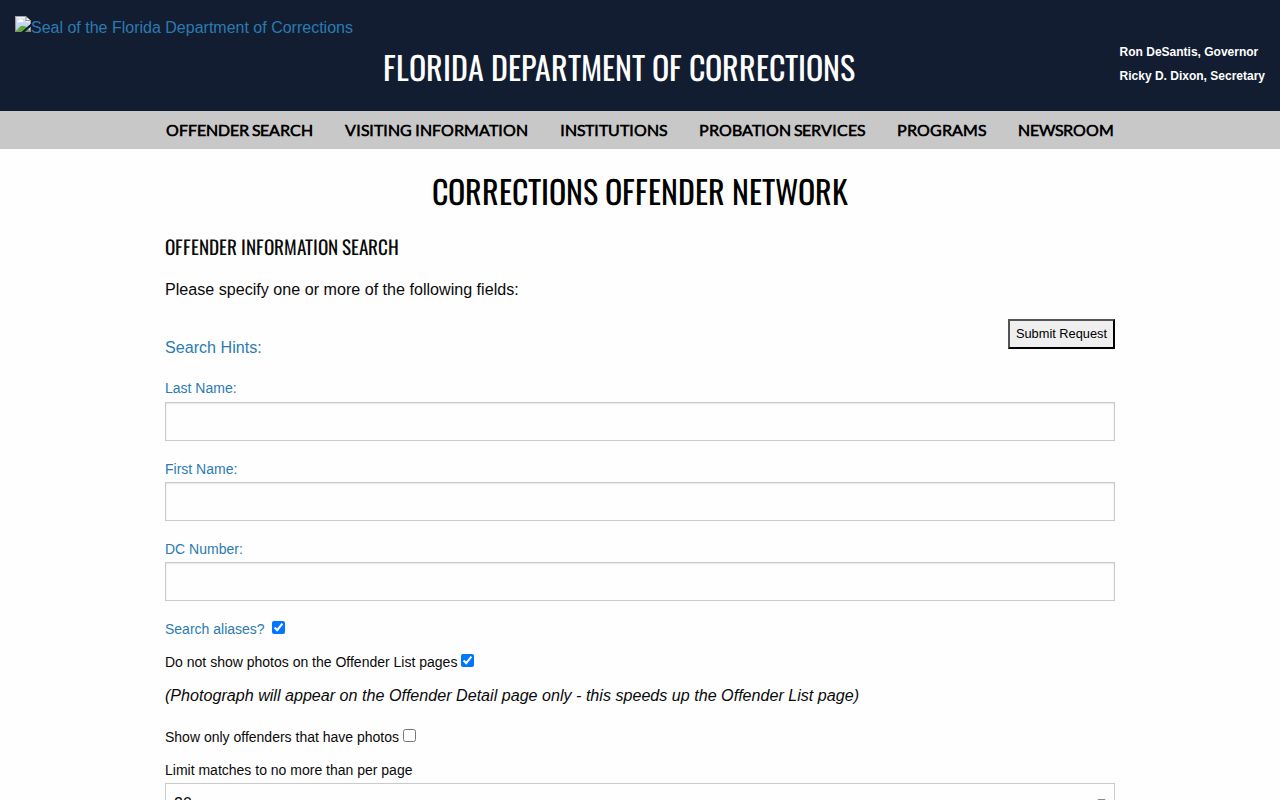
The population choices show why a released or supervised search is different from a current-inmate lookup.
Monroe County Recent Release Data
MCSO publishes one official release product with a stated seven-day window. It does not publish named twenty-four-hour or seventy-two-hour feeds. A reader may compare each release timestamp with the current time to derive a shorter set, but that remains a user calculation. The table omits photos, charges, release reasons, destinations, case numbers, and supervision fields.
Freshness needs special care. During research on July 14, 2026, the backend for the official page showed a May 2025 update and an April 2025 release, even though the live jail log carried a current timestamp. That conflict proves the release display can become stale or malfunction. It does not prove a lack of releases. Inspect the newest row, compare the current jail log, and move to MCSO Central Records and the Clerk when the data is empty or old.
Note: The arrest page can retain a booking photo after roster departure, but only a release record or agency confirmation proves the release event.
Monroe County Release Supervision
FDC Community Corrections supervises probation, community control, and several post-prison populations. The Florida Commission on Offender Review handles decisions within its parole and conditional-release authority. Probation can begin without a prison stay. Parole is largely a legacy mechanism for older offense and sentence structures, so every supervised person should not be called a parolee.
Search the FDC supervised population and read the exact status and current office. Circuit 16 has offices in Key West, Marathon, and Tavernier, and assignment can change with residence or case administration. An absconder or warrant result does not itself prove a return to custody. Cross-check FDC, the MCSO live jail log, active warrants, and the case docket. The Monroe County post-release supervision page covers those verification steps and the local offices.
Resources After Monroe County Release
MCSO's January 2026 handbook says community-resource information is available through Inmate Programs and that an Intake/Release Officer can provide it during processing out. The same source describes in-custody intervention and transition or discharge preparation. This is a route to information, not evidence that each released person enrolled in or received a specific service.
Ask for the current resource sheet while release is being processed. Needs and available programs can change, so the handbook should be treated as a dated navigation source. Court-ordered Pretrial Services, FDC supervision, and voluntary community resources are different forms of support and should not be merged into one status.
Monroe Release Alerts and Registries
Florida VINE covers all county jails and FDC according to state program material. Search one person by name or offender ID, resolve duplicates with a middle initial or birth date, and choose the correct agency record. A person can have separate MCSO and FDC episodes. Alerts distinguish release, transfer, escape, work-release placement, another-jurisdiction transfer, return to custody, and death, so report the event exactly as VINE sends it.
The FDLE registry is a specialized source, not a general inmate locator. Its “Released - Subject to Registration” filter can confirm that a covered registrant is no longer confined or supervised while registration continues. Absence has no meaning for a nonregistrant, and FDLE says fingerprints are required for positive identity. VINE is time-sensitive rather than a certified permanent archive; records requests and agency systems remain the lasting sources.
Monroe Court Release Records
The Monroe Clerk criminal portal preserves docket history after the short jail displays expire. Name searches require first and last name, date searches need both endpoints, and results stop at five hundred. Location suffixes tied to Key West, Plantation Key, and Marathon can help interpret the case. Search a narrow range and read the full chronology for first appearance, bond changes, Pretrial Services, dismissal, sentence, jail credit, probation, violation, revocation, termination, or discharge.
A court order date is not the jail exit time. The docket explains authority, while MCSO documents the operational event. Confidential, sealed, expunged, juvenile, mental-health, and other protected matters can disappear from anonymous access, making a negative result inconclusive. Three Clerk offices provide local access in Key West, Marathon, and Plantation Key.
Federal Transfers from Monroe Custody
A person who leaves MCSO may remain confined under another authority. MCSO's handbook refers to U.S. Marshals, Border Patrol, and Customs populations, and historic ICE inspections document immigration use at Main. Those sources do not prove that any specific contract remains active today. Check the person, not an assumed institutional arrangement.
The BOP locator covers federal prisoners from 1982 onward. A past date with RELEASED or no facility means departure from BOP custody, not the end of supervision or another hold. USMS has no public historical release locator, so the federal court docket supplies detention and release orders. ICE ODLS searches by A-number and country of birth or exact name, birth date, and country; it may show recent releases for about sixty days, subject to lag and omissions.
Match Monroe Release to Custodian
Each system proves only its own custody status. The safest lookup follows the chain from the latest known agency and distinguishes current detention from a completed release or transfer.
| Source | Still in custody | Released or transferred |
|---|---|---|
| MCSO jail log | Current unit, charges, and bond | Roster absence alone proves nothing |
| MCSO release table | Not a current roster | Local facility, booking time, and release time |
| Monroe Clerk | Detention and bond orders | Disposition, sentence, probation, or release authority |
| FDC Offender Search | State prison location and projected date | Released status, history, or supervision office |
| BOP locator | Federal facility or transit status | Past federal release date and no BOP facility |
| ICE ODLS | Current ICE result when available | Recent ICE release, subject to retention and lag |
Monroe County Release Facilities
The facility field matters across the Keys. Main, Marathon, and Plantation Key are distinct MCSO locations, while the remaining pages explain the state, supervision, and federal systems that can receive or track a person after local custody.
- Monroe County Detention Center: Main on Stock Island handles local adults and may transfer people to state or federal custody.
- Plantation Key Detention Facility: confirm whether the row marks community release, movement to Main, or another authority.
- Marathon Detention Facility: a short hold or movement to Main is not a community release.
- Florida Department of Corrections: statewide prison release and discharge data for state-sentenced people.
- Monroe Community Corrections: assigned supervision offices, not detention facilities.
- Federal BOP, USMS, and ICE: separate paths for sentenced federal custody, pretrial federal custody, and civil immigration custody.
The Monroe Regional Juvenile Detention Center is not part of the adult released-inmates page set. Youth placement and release information belongs only in authorized DJJ and court channels. No youth-identifying data should be collected or published through the adult MCSO feed.
Note: Record the named facility before traveling because Key West, Marathon, and Plantation Key offices are spread across a long county.