
Monroe County Mugshot Records
A booking photograph documents appearance during a specific arrest intake. Release does not turn the image into a release record, erase the arrest, prove guilt, or show the person's current location. Florida public-record law generally permits access to agency records unless a specific exemption or confidential status applies. Juvenile information, sealed or expunged records, protected personal data, and active investigative material in defined cases can be withheld or redacted.
Monroe County has an important source split. MCSO's recent-arrests display includes booking images and arrest details. Its separate release table includes an actual release time but no photograph. The sound method is to match the same booking episode across the two official sources with name, birth data or age, arrest and booking time, facility, incident or case details, and release row.
A mugshot that still appears after release is still tied to the arrest. It does not show whether the case was dismissed, resolved, sealed, or still pending. The Monroe Clerk docket supplies that legal context.
Monroe County Mugshot Sources
No one source covers every person released in Monroe County. County jail, state prison, registry, warrant, and press images arise from different events. Start with the custodian and time period, then use official identifiers to prevent a same-name mismatch.
| Channel | Has a photo? | How to access |
|---|---|---|
| MCSO recent arrests | Yes, when the arrest remains displayed | Search the official seven-day arrest display |
| MCSO seven-day releases | No photo field | Use it only to verify release time and facility |
| MCSO mobile app | Arrests feature documented | Check the current official app; do not assume a release archive |
| MCSO records request | Existing booking photo may be produced | Request by booking number, date, and facility |
| FDC Offender Search | Often, for state corrections records | Match a person who entered Florida state custody |
| FDLE registry or MCSO warrant page | Yes, for covered records | Use only for the registry or warrant purpose |
| Press and outside archives | Sometimes | Treat as a discovery lead and verify with official records |
Florida VINE may show person and custody details, but it is a time-sensitive notification service rather than a guaranteed photo archive. A commercial repost may persist after an official page changes. Do not treat a copied image as a current agency record.
Note: The photo source identifies an event; only the MCSO release row, docket, FDC history, or agency record confirms custody ended.
Monroe County Arrest Photo Match
The official MCSO arrest display shows a photo-rich recent-arrest record, while the release display has no image column. The captured official screen illustrates that separate arrest channel.
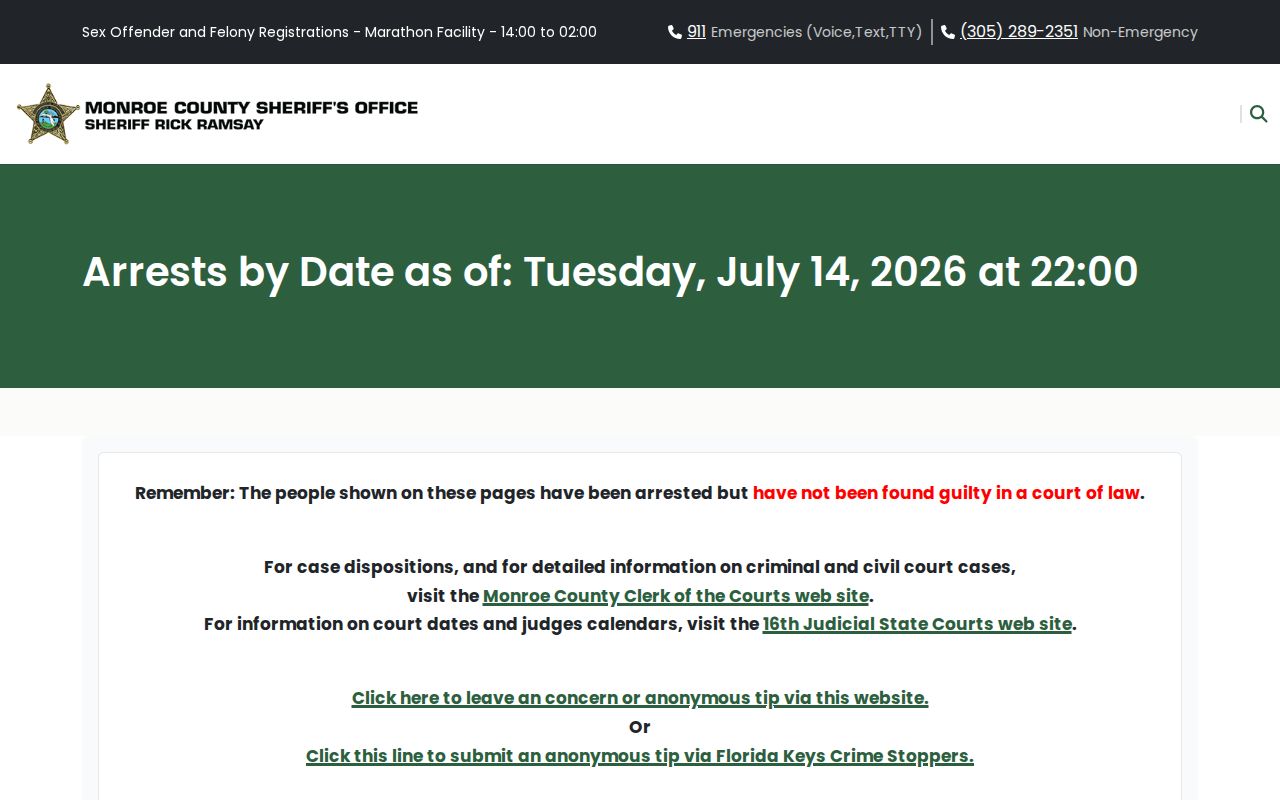
The screen should be used to identify a booking episode, not to infer present custody or release. Compare its details with the independently dated release row.
Search the arrest display by the available name and date details. Then open MCSO's Inmate Releases for the Last Seven Days and look for the same person and booking. Confirm facility because Main, Marathon, and Plantation Key are separate sites. The release row supplies booking and release timestamps and bond amount, but not reason or destination.
The Monroe County 24-Hour Releases method explains how to derive a one-day window from that seven-day table. It is not an official photo feed. If either source is stale or the booking aged out, use the Clerk and MCSO records request rather than assuming the photo or release never existed.
Monroe County Sheriff App Photos
MCSO's official mobile app serves the Florida Keys. Its version history documents an Arrests feature with search and sorting, plus a separate Sex Offenders feature. That evidence supports the app as an arrest-photo discovery channel. It does not prove a dedicated recent-release screen, a released-mugshot archive, or permanent photo retention.
The official MCSO app listing provides the source for the current product and its documented feature history. The captured listing shows which app is the agency's own product.
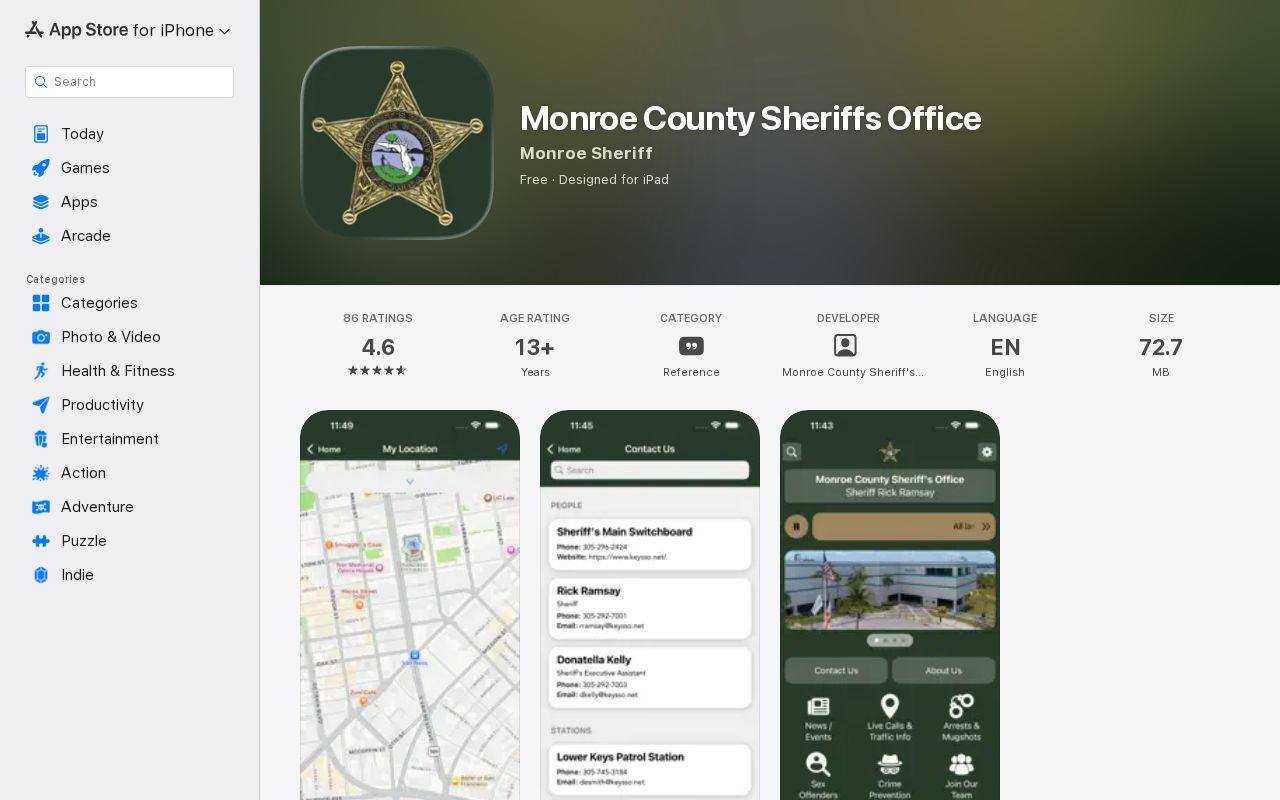
Test the current app screen before relying on any feature because app functions can change. If it opens the web arrest display, the same short-window and identity limits apply.
Match an app photo to the release table through stable details, not appearance alone. A photo on the app can remain visible after a name leaves the current jail log, but the release timestamp still comes from the release record.
Request a Monroe County Booking Photo
When the online arrest display has expired, send a focused request to MCSO rather than the County Commission's general records portal. Use the MCSO JustFOIA portal. An exact booking number is best, but a full name, birth date, approximate booking date, and facility can help locate the existing record.
- Identify the person and booking episode with the full name, date of birth, booking number, date range, and MCSO facility.
- Ask for the publicly releasable booking face photograph tied to that episode. Also request booking and release timestamps if both are needed.
- Request electronic delivery and a cost estimate before the agency incurs extensive charges.
- If material is withheld, ask for the statutory basis and a written explanation for each redaction or denial.
- Compare the returned photo and booking number with the Monroe Clerk case and MCSO release event.
Florida Statutes §119.07 requires prompt acknowledgement and a good-faith response, not a fixed number of days. Standard copy fees may apply, and extensive clerical, technical, or supervisory work may support a special-service charge based on actual resource cost. A narrow electronic request can reduce both delay and expense.
MCSO Central Records
Monroe County Sheriff's Office
5525 College Road
Key West, FL 33040
305-292-7050
Online portal preferred
Florida Photos After Monroe Release
A person transferred from MCSO into Florida prison did not return to the community at the county release event. Search the FDC Offender Search after state intake. A released FDC detail can retain a corrections photograph, DC number, state custody history, status, and release data long after MCSO's short public window expires.
That FDC image is a state corrections photograph. It does not cover a person whose only custody was in a Monroe County jail. Confirm identity through DC number and case details. If the record shows a past release from prison plus active Community Corrections supervision, the person left prison but has not necessarily reached full discharge.
The FDLE Sexual Offender and Predator Registry is another narrow channel. It may show photos, aliases, Monroe County, and a “Released - Subject to Registration” status for a covered registrant. It is not a general booking-photo search. Absence says nothing about a person outside that statutory population, and FDLE states that fingerprints are required for positive identification.
MCSO warrant pages can also show a photo. A warrant image documents an active warrant listing, not present jail custody and not a completed release.
Monroe County Mugshots in News
MCSO press material and local news may preserve selected arrest photos. Coverage is not complete. The article date, event description, person identifiers, and case should all match before the image is associated with a booking. A press item cannot replace an official MCSO release time or FDC custody history.
Third-party archives may copy old arrest pages and keep images after an official display changes. Their dates, edits, identity matches, and removal practices can vary. Treat them only as leads that require MCSO, FDC, or court confirmation. No commercial mugshot publisher or removal service is endorsed or linked here.
A no-photo result is inconclusive. The source may have aged out, the record may be exempt or confidential, the booking may belong to another authority, or sealing or expungement may affect access. Move back to the originating agency and case docket.
Note: News and copied archives are selective and can be old, so preserve the event date and verify the official booking record.
Monroe County Mugshot Expungement
Monroe County publishes local petition and affidavit forms for sealing or expunction. Florida's statewide process begins with an FDLE Certificate of Eligibility, but that certificate is not a court order. The person must petition, the court decides, and the affected records change only after agencies implement the certified order.
The Monroe petition form works with the FDLE seal and expunge process. FDLE's packet calls for the required application, certified disposition, fingerprints, and supporting papers. Expunction also calls for the prosecutor's certified statement. Eligibility and implementation are record-specific.
Anonymous court access excludes sealed and expunged matters and other confidential cases. Yet an old outside copy may not vanish at the same moment. Preserve needed personal or legal copies before expunction because an expunged record generally cannot later be released even to the subject without a court order.
Florida Mugshot Removal Procedure
Florida Statutes §901.43 creates a precise removal path for a covered commercial mugshot publisher. The person shown, or a legal representative, sends a written request by registered mail with enough identity proof and enough detail to identify the specific photo. A covered publisher must remove the image without charge within ten calendar days and may not republish it.
The statute also bars a covered business from soliciting or accepting payment to remove the booking photo. Noncompliance or republication can support statutory remedies. Its coverage is limited to the commercial conduct defined in the law. It does not command every sheriff, government portal, news organization, or public-interest publisher to erase a lawfully held image.
Removal under §901.43 is not sealing or expungement. A commercial copy can be removed while the source arrest record remains public, and a court order can affect official access through a separate process. Send any official-record question to the agency that holds the photo and ask for the legal basis if access or removal is denied.