
Monroe County Parole and Probation
A release from the Monroe County Detention Center only establishes that MCSO custody ended. It does not establish supervision. Florida Department of Corrections Community Corrections administers probation, community control, and several forms of post-prison supervision. The Florida Commission on Offender Review, or FCOR, makes decisions within its parole and conditional-release authority. The agency and record type must match the question.
Probation is a court-ordered community sentence. It can follow jail, follow prison, or take the place of incarceration. Parole is discretionary early release for a limited, mainly older group of Florida cases. Florida's Criminal Punishment Code largely ended Chapter 947 parole for people sentenced under the newer framework, so “parole” is not a sound catchall for anyone reporting to an officer.
| Point | Parole | Probation |
|---|---|---|
| Decision source | FCOR within its statutory authority | Sentencing court |
| Prior prison term | Usually follows prison release | Not always required |
| Public verification | FDC status, FCOR records, assigned office | FDC supervised search, court docket, assigned office |
| End point | Discharge or sentence end shown in the governing record | Court or agency termination and discharge |
- Community control
- A restrictive form of community supervision ordered by a court.
- Discharge
- The formal end of the supervision term, not merely release from jail or prison.
- Absconder
- A person whom the supervising authority reports as having left supervision without permission.
- Detainer
- A request or notice that another authority may take custody.
Verify Monroe County Release Supervision
The FDC Offender Search separates released, supervised, fugitive or absconder, escape, and all-database populations. Choose a population that can return supervision records. A county jail roster is not the right tool after release, and a Monroe County conviction does not guarantee that the person reports to a Key West office.
- Search by DC number when known. Otherwise use the full name and compare personal and case details.
- Open the matching record and read the exact current status. Do not substitute “parole” for probation, conditional release, or community control.
- Record the current Community Corrections office shown on the result. Confirm it in the official office directory.
- Check the Monroe Clerk criminal docket for the sentencing order, probation term, violation, revocation, termination, or discharge.
- If the record suggests flight or a violation, check the FDC absconder population and MCSO warrant source separately.
- Ask the assigned office what public status it can verify when online records conflict or appear stale.
The complete county release path, including MCSO release records and court cross-checks, appears on the Monroe County released-inmate search. Use it when the first issue is whether MCSO released or transferred the person.
Monroe County Supervision Offices
FDC Circuit 16 spans the Keys. Its listed offices are geographically separate, which makes the office field on a supervised-population record useful. Assignment can turn on residence and can change. The official directory should control over an old saved address or an assumption based on the conviction court.
The Circuit 16 office directory lists the circuit headquarters and field offices. For a formal status question, provide the DC number and ask which public supervision and office facts may be confirmed.
The official FDC Circuit 16 page shows the office network used to route Monroe County supervision questions.
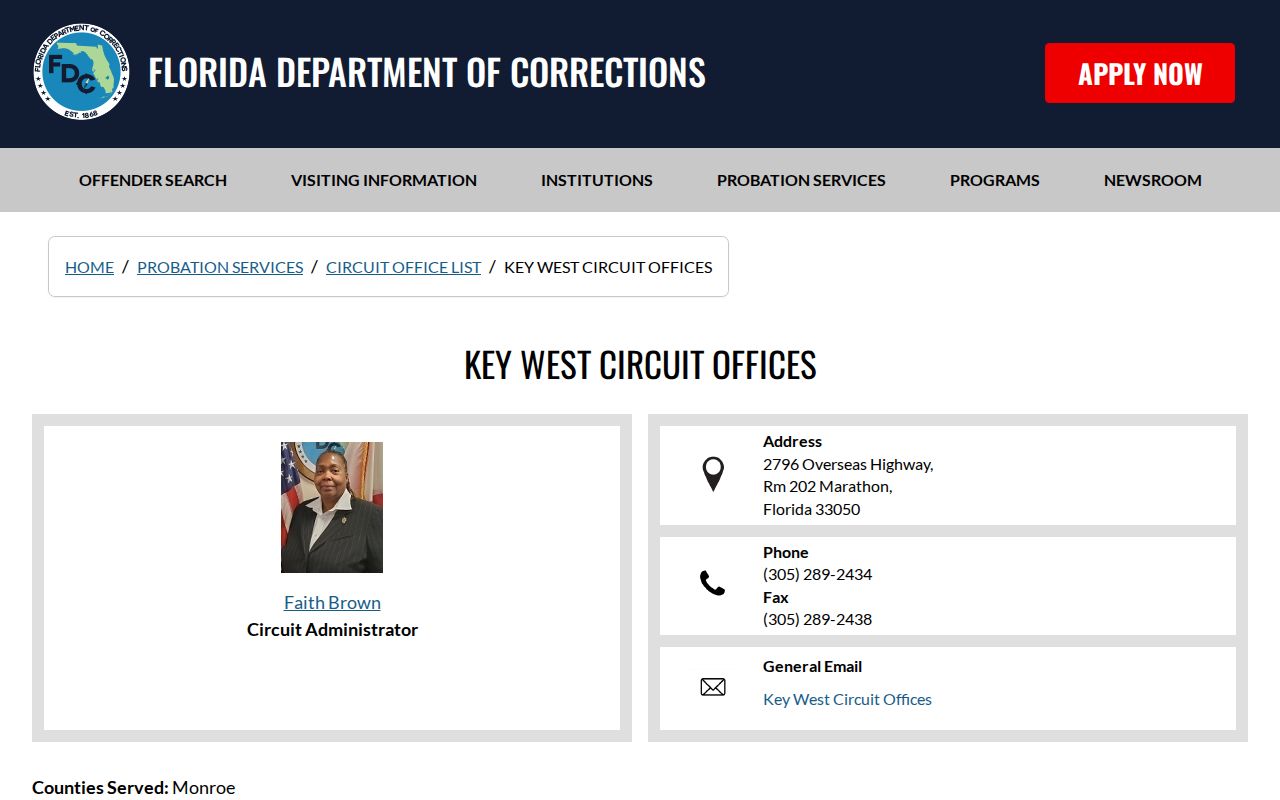
The directory image reinforces why the current office field matters before a person travels or calls about a supervision record.
FDC Circuit 16 Community Corrections
Circuit headquarters
2796 Overseas Highway, Room 202
Marathon, FL 33050
305-289-2434
keywest.cir@fdc.myflorida.com
Field offices
Key West Office 160: 1111 12th Street, Suite 402, 305-292-6742
Marathon Office 161: circuit headquarters, 305-289-2434
Tavernier Office 162: 88005 Overseas Highway, Islamorada, 305-853-3262
FDC also lists Community Supervision at 850-717-3444 and co-supervision@fdc.myflorida.com. Recheck assignment and contact details before travel.
Note: A Monroe County case may be supervised from any listed Circuit 16 office, and the active FDC record is the best routing source.
Monroe County Supervision Warrants
An absconder entry and an active warrant answer different questions. FDC may list a person in its fugitive or absconder population. MCSO maintains letter-indexed active warrant pages that can display a photograph, warrant number, issue date, charge, and bond. A later failure-to-appear or supervision-related warrant can follow a valid release.
Neither listing proves that the person is now jailed. Confirm current custody through the correct agency and read the Monroe Clerk docket for the violation filing, warrant, arrest event, revocation, or later disposition. A warrant is an order to take a person into custody. A revocation is the legal action that ends or changes supervision after the required process. Do not treat one as the other.
MCSO warns the public not to approach a wanted person. Use official contact channels. For FDC absconder questions, the published Absconder Unit is 850-717-3475 on weekdays from 8 a.m. to 5 p.m.
Monroe County Parole Hearings
FCOR parole work is chiefly relevant to legacy eligibility categories. Its rolling voting schedule links meeting dates to agendas. Those dates may occur several times in a month, often weekly, but the agency does not promise one fixed weekday. An agenda can show the name, DC number, category, county, offense, case number, and whether the matter goes to a panel or full commission.
Eligibility is not release. Florida Statutes §947.16 generally sets an initial interview within eight months for terms of three years or less, fourteen months for more than three but less than six years, twenty-four months for terms of six years or more other than life, within five years for life, and within eight months for a youthful offender. Mandatory minimums and special groups can alter those rules. Under §§947.172, 947.174, and 947.1745, the process may involve a presumptive parole release date, later review, and an effective parole release date tied to an acceptable plan.
An agenda is not a result page. No separate public final-decision search was located. Request the vote sheet, Commission action or final order, PPRD or EPRD action, and any later modification, revocation, or discharge order from FCOR Public Records at fcorlegal@fcor.state.fl.us or 850-848-4460. Commission Clerk post-release questions go to 850-488-1293.
Note: Conditional release, conditional medical release, addiction recovery supervision, legacy control release, and parole are distinct FCOR terms.
Monroe County Supervision Changes
Conditions come from the court order, FCOR action, or another governing release document. They can include reporting, travel limits, treatment, payment duties, or other case-specific terms, but the exact record controls. A violation allegation can lead to a warrant, hearing, modification, revocation, or return to custody. It does not erase the earlier release event.
Florida VINE can issue notices for some custody and community-supervision changes, including release, transfer, absconding, capture or return, and changes in supervision. Each term should be reported as stated. A VINE alert is time-sensitive notice, not a permanent certified record, and one person may have separate MCSO and FDC agency records. Use the official docket or FDC record for durable verification.
Supervision ends through a formal discharge, termination, sentence expiration, or other governing action. Look for the FDC status, court termination or satisfaction entry, and any FCOR discharge order that applies. Simply reaching an expected date is not enough if a later order, violation, or recalculation changed the term.
Monroe County Release Resources
MCSO's January 2026 inmate handbook says community-resource information is available through Inmate Programs and that an Intake/Release Officer can provide it during processing out. The handbook also describes intervention and transition or discharge preparation while a person remains in custody. These are local navigation options, not proof that a person took part or received a named service.
Someone leaving MCSO for FDC, ICE, USMS, or another county has not entered ordinary community release. That person should follow the receiving authority's process. For a community release that includes probation or post-prison supervision, the assigned Circuit 16 office is the key reporting source. The long distance between Keys offices makes it prudent to verify the office before a trip.
Monroe County Release Property Deadlines
Supervision verification does not resolve property or account issues from MCSO custody. The current MCSO handbook says stored property is normally returned at release, while bulk items must be picked up from the facility where they were held. It gives a 30-day deadline after release or transfer for bulk property. That facility-specific rule matters when Main, Marathon, and Plantation Key are far apart.
Pending commissary has a separate five-working-day claim rule. The newer handbook says money left after MCSO debt is returned on a debit card. Those facts concern release processing only. They do not indicate parole, probation, discharge, or the destination after MCSO custody. Contact the originating facility promptly and keep the booking and release details available.
Note: Property and account deadlines run apart from probation reporting, so contact both the facility and assigned office when both apply.